


How the Building Safety Act and Section 20 consultations are colliding—and how to protect your funds.
For years, Property Managers, Right to Manage (RTM) companies, and Resident Associations followed a predictable, well-trodden path when a major lift modernisation or replacement became due. You obtained a diagnosis of the lift’s issues, ran your Section 20 statutory consultations, chose your contractor, and started on-site.
See our article on conducting major works to lifts here:
FLM: https://www.flat-living.co.uk/a-guide-to-major-works/
Today, that relatively straightforward path contains a major regulatory trap.
If you manage a residential building over 18 metres high (or seven storeys)—defined as a Higher-Risk Building (HRB)—two completely separate pieces of UK legislation are now in a direct, costly conflict. The Building Safety Act (BSA) 2022 and Section 20 of the Landlord and Tenant Act 1985 are pulling Property Managers in opposite directions.
At Ardent Lift Consultancy, we are seeing this regulatory friction first-hand. Without careful planning, this legal gridlock can easily lead to spiralling project costs, broken contractor relationships, and the legal nightmare of having to restart your Section 20 consultation process from scratch.
Here is exactly what is happening, why it threatens your Block’s budget, and how you can successfully navigate it.
Gateway 2 vs. The Section 20 Notices
To understand the problem, we have to look at how these two laws conflict during a lift refurbishment project:
1. The Building Safety Act Rule
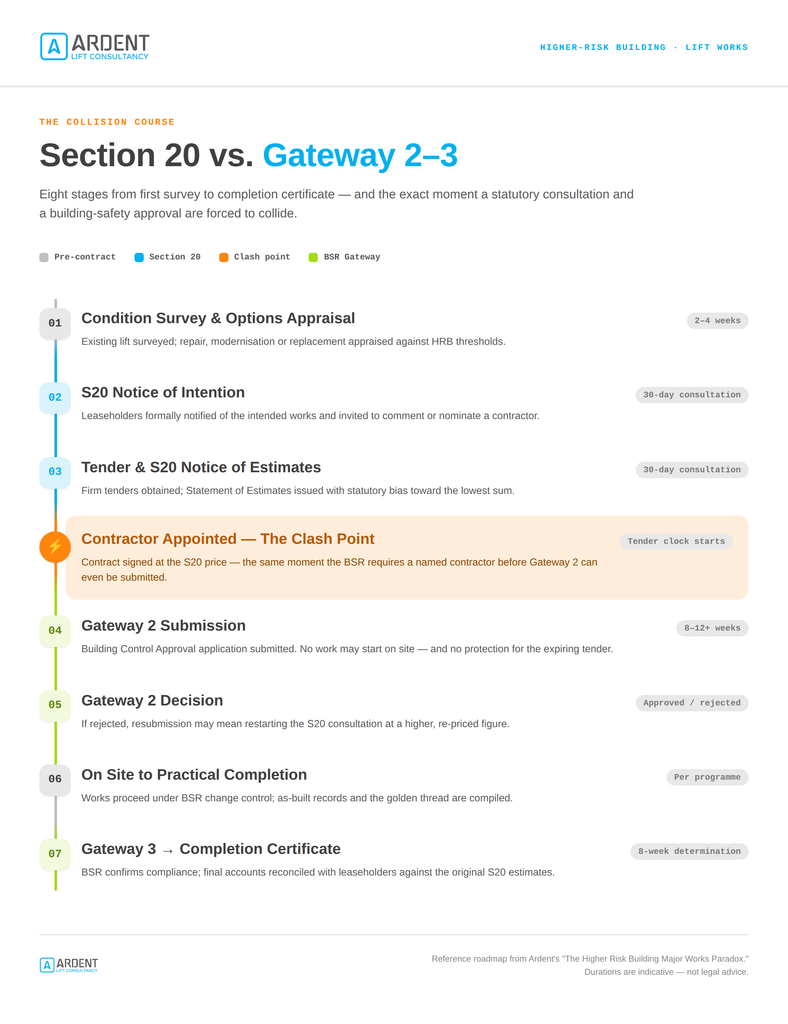
Major lift works can change the structural and safety profile of an HRB. This means they cannot begin until the Building Safety Regulator (BSR) grants explicit approval via Gateway 2. Crucially, the BSR will not accept a vague or theoretical plan. Their submission portal requires you to name and submit the exact, specific lift contractor who will perform the work, alongside their competency statements and full technical designs.
In short: you must formally appoint your contractor before you can even ask the BSR for permission to undertake the works.
2. The Section 20 Consultation Rule
Under Section 20, after following the Notice of Intent period and having the works tendered and specified, you must issue a Statement of Estimates giving leaseholders 30 days to review the competitive tenders collected. Once that period ends, you are legally clear to sign a contract with your chosen Lift Contractor based on the prices they quoted.
The Clash
Once you award the contract to satisfy the BSR, you must upload your Gateway 2 submission.
The BSR then has a statutory review period of 8 to 12 weeks (and frequently longer due to severe application backlogs).
During these three to four months of waiting, your chosen Lift Contractor is legally forbidden from undertaking any works on site. They are stuck in limbo, yet their business overheads, factory material costs, and labour rates continue to shift.
The Financial Sting for Leaseholders
This enforced holding period can trigger a potential financial chain reaction.
- The Expiring Quote: Standard commercial lift manufacturing tenders are usually only valid for 60 to 90 days. Because the BSR application process takes months of preparation and approval time, the contractor’s price guarantee will almost certainly expire before they are legally allowed to commence.
- The Price Hike: Facing global supply chain fluctuations, the contractor will likely request an uplift in costs (often linked to the rising Lift & Escalator Industry Association indexes).
- The Section 20 Collapse: This is the potential pitfall. If the contractor’s price increases significantly above the original figure listed in your Section 20 Statement of Estimates, your original statutory consultation may become legally invalid, as the appointed Lift Contractor may no longer be the most economically viable bid.
If a First-tier Tribunal (FTT) rules that leaseholders were consulted on a figure that no longer matches reality, the Property Manager might be unable to legally recover the extra costs through service charges. To fix it, you are faced with a dilemma: absorb the financial deficit or halt the project entirely to run a brand-new, 30-day Section 20 consultation using the higher prices and potentially running the risk of further objections.
This could, if your lift is in a degrading condition (or if it has failed completely), lead to the building being without lift service whilst these statutory obligations are followed and the residents of the block being hugely inconvenienced whilst the requirements of each part of the legislation is followed.
How to Protect Your Block: The Ardent Strategy
While the industry waits for the government to reform this legislative oversight, residential developments cannot simply leave their lifts on the point of failure. Managing Agents and RMCs must adapt their procurement strategies immediately.
At Ardent Lift Consultancy, we have developed a specialised roadmap to insulate leaseholders from these risks during lift modernisations:
- Contractually Robust Tender Validity: Do not accept standard term quotes. We mandate in our initial technical specifications that all bidding lift contractors must contractually lock in their pricing for a minimum period to absorb the BSR waiting window.
- Turnkey combined Lift Consultancy and PD BSA: We are experts in lift modernisation projects, it is what we do day in and day out, with over 100 years of combined experience within our project team. We are best placed to collate the information required for the BSR Gateway 2 application during the tender period, meaning we can submit the application at the point of Lift Contractor instruction (streamlining the timescales required).
We Are Here to Support You
Navigating vertical transportation engineering is complicated enough on its own; layering complex property litigation on top can make it feel impossible.
Ardent Lift Consultancy specialises exclusively in bridging this exact gap. We provide the deep engineering expertise required to spec and oversee your lift modernisation, combined with the strict procurement knowledge needed to keep your project fully compliant with both the Building Safety Regulator and landlord-tenant law.
Do not let regulatory friction drain your reserve funds or delay your building’s essential repairs. Contact our team today to ensure your next lift project is legally sound, financially protected, and engineered to last.