


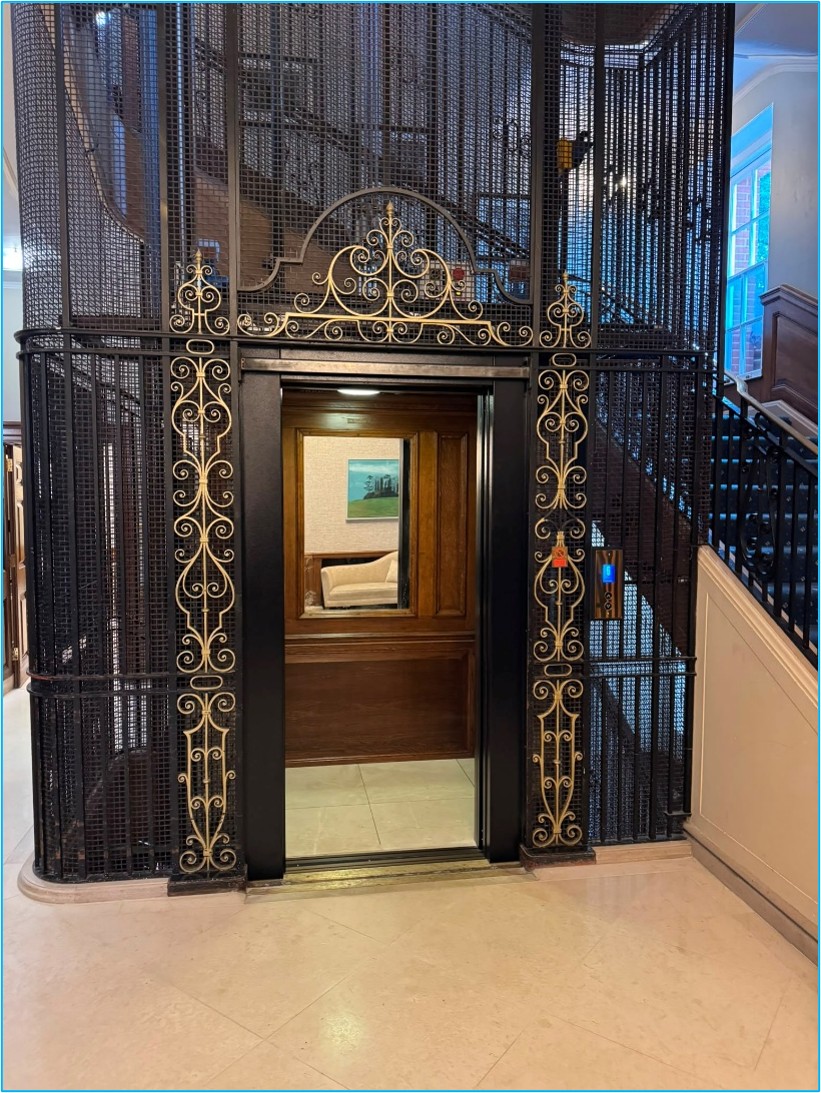
Historic and listed buildings are often valued for the things that make them different. Original staircases, ornate entrances, decorative ironwork, timber panelling and period features all contribute to the character of a building.
But what happens when one of those features is the lift?
For residents of historic mansion blocks and converted buildings, the lift can be much more than a means of getting from one floor to another. An original lift may form part of the architectural character of the building, particularly where it occupies a prominent stairwell or lightwell and retains features such as a glazed car, decorative metalwork or traditional lift gates.
The challenge is that the technology behind these historic installations does not stand still.
A lift may have been beautifully designed 80, 100 or even more years ago, but it still needs to provide a safe and reliable service to today’s residents and maintenance engineers.
That creates an interesting balance between preserving the past and making the lift fit for the future.
A history of innovation
The history of the lift is one of continual development.
Early lifting systems were relatively simple mechanical arrangements, but the development of reliable safety devices in the nineteenth century transformed the possibilities for passenger transportation within buildings.
Elisha Otis is perhaps the best-known name associated with this development. His demonstration of a lift safety device in New York in 1854 helped demonstrate that a passenger lift could be equipped with a means of arresting the car in the event of a suspension failure.
The subsequent development of electric traction lifts, improved control systems and automatic landing doors eventually produced the technology that we would recognise as the modern passenger lift.
However, many of the earlier designs have not disappeared completely. They can still be found in historic residential buildings throughout the UK, particularly in London and other major cities.
When the lift is part of the architecture
Some historic residential buildings contain lifts that are works of art in their own right.
Open metalwork shafts, decorative gates, glazed cars and ornate finishes can form an important part of the building’s visual character. In some cases, the lift sits within a central lightwell and is visible from communal areas and multiple floors.
This creates a dilemma when the equipment begins to deteriorate.
A modern replacement lift could provide automatic doors, improved ride quality, modern controls and better accessibility. It may also be considerably easier to maintain. But simply removing the old installation can mean losing an important part of the building’s character.
Conversely, retaining every component simply because it is old is not necessarily the right answer either. Historic significance does not make equipment immune from safety considerations. The most successful projects therefore tend to start with a much more fundamental question:
What is actually important about the existing lift, and what needs to change?
Safety versus preservation
This is where refurbishment becomes particularly interesting.
Historic lifts can contain features that would never be incorporated into a new installation. Traditional lattice gates are a good example. They can be visually striking and may be an important part of the lift’s appearance, but they can also present safety challenges.
The answer does not always have to be complete replacement.
Depending on the individual installation, it may be possible to retain significant elements while introducing modern safety measures elsewhere. Controls, electrical systems, door equipment, safety circuits, communications, lighting and other components can potentially be upgraded while retaining selected historic features.
The solution will always depend on the particular lift and the significance of the building.
It is therefore important that the project team understands both sides of the problem: lift engineering and heritage conservation.
Listed does not mean untouchable
One common misconception is that listing a building means that nothing can be changed.
That is not the case.
The purpose of the heritage protection system is not simply to freeze a building in time. Instead, proposed changes should be considered in terms of their effect on the building’s architectural or historic significance.
Historic England’s current guidance emphasises the importance of understanding what makes a heritage asset significant before developing proposals for alteration. For listed buildings, works which affect that special interest may require Listed Building Consent.
For a lift refurbishment, this means that the process should ideally begin well before the lift contractor arrives on site.
An assessment of the existing lift can identify which elements are historically important, which are later alterations and which are simply obsolete equipment that can be replaced without affecting the character of the building.
This can make the subsequent design and consent process considerably more straightforward.
The problem of obsolete technology
There is another challenge that is less visible but increasingly important: obsolescence.
A lift installed several decades ago may still contain beautifully engineered mechanical components, but the electrical control equipment could be approaching the end of its useful life.
Original manufacturers may no longer exist. Components may no longer be manufactured. Drawings and wiring diagrams may have disappeared. Even apparently simple replacement parts can become difficult to source.
This is one reason why a lift can sometimes appear to be mechanically sound but nevertheless become increasingly difficult and expensive to maintain.
Modernising the control system, drive equipment and safety circuits can extend the opperational life of an installation while retaining the parts of the lift that give it its historic identity.
For residents, the result can be a lift that still looks as though it belongs in the building but behaves much more like a modern installation.
Accessibility and the expectations of today’s residents
Historic buildings were obviously not designed around today’s expectations of accessibility.
Lift cars can be small. Door openings can be narrow. Landing arrangements may be awkward, and controls may be positioned in locations that are no longer ideal (or compliant).
A refurbishment provides an opportunity to consider whether improvements can be made without compromising the historic fabric.
Not every building will allow a perfect modern solution. Space constraints, structural limitations and heritage considerations can all restrict what is possible.
But improvements such as clearer controls, improved lighting, better communication systems, automatic door operation and smoother acceleration and deceleration can make a significant difference to residents’ experience.
The important point is to consider accessibility as part of the overall refurbishment rather than as an afterthought.
Energy efficiency without losing the character
Modern lift technology can also offer significant improvements in efficiency.
Older lift systems can use relatively inefficient motors, controls and lighting, while modern variable-speed drives, efficient motors, LED lighting and standby functions can reduce energy consumption.
However, the most energy-efficient solution is not necessarily to replace everything.
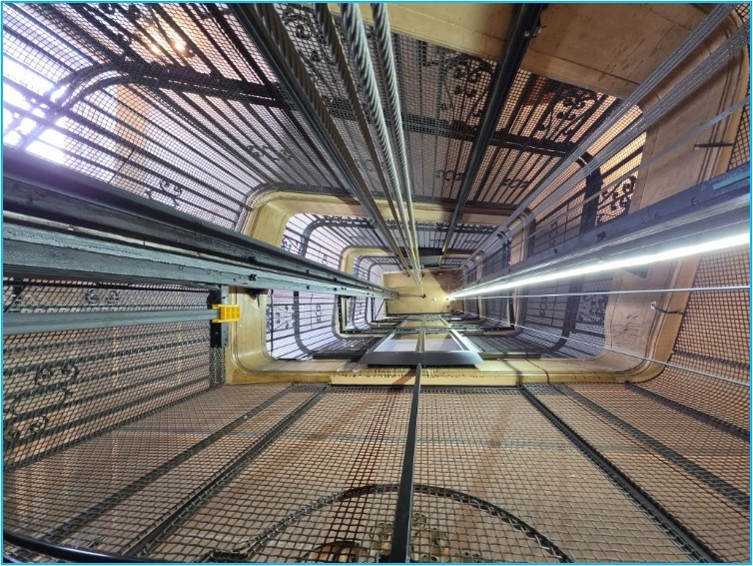
A well-designed refurbishment can allow the existing structure, shaft, car or other suitable components to be retained while upgrading the equipment that has the greatest impact on energy use and reliability.
Historic England’s current guidance also recognises that historic buildings can be adapted to improve energy efficiency and reduce carbon emissions, provided that the significance of the building is properly considered.
For residential buildings, this can make a refurbishment a useful opportunity to address both reliability and energy performance at the same time.
So, should an old lift be replaced?
Not necessarily.
The correct answer depends on the condition of the equipment, its remaining useful life, the availability of spare parts, the level of safety achievable through refurbishment, the requirements of the building and, importantly, the significance of the historic installation.
For some buildings, complete replacement will be the most sensible option.
For others, a carefully planned refurbishment may provide a much better balance between safety, reliability, cost and conservation.
The key is not to start with the assumption that everything must either be preserved or replaced.
Instead, each component should be considered on its merits.
What is historically important?
What is technically obsolete?
What can be improved?
And what should be retained?
Looking after tomorrow’s historic lifts
There is also a longer-term lesson for today’s building owners.
The best time to understand the importance of a lift is not when it has already failed and replacement parts are no longer available.
A planned programme of inspection, maintenance and condition assessment can identify approaching obsolescence before it becomes an emergency.
For historic buildings, maintaining good records is particularly valuable. Original drawings, photographs, specifications and information about previous alterations can all help future engineers and conservation professionals understand what is there and why.
Today’s modern lift may eventually become tomorrow’s historic lift.
The installations we choose to preserve, upgrade and maintain now could themselves become part of the architectural story of the building in decades to come.
For owners and residents of historic properties, the objective should therefore be more than simply keeping an old lift running.
It should be about finding the right balance between heritage, safety, reliability, accessibility and sustainability—allowing a piece of the building’s history to continue serving the people who live there.
At Ardent, we work with building owners, managing agents and residential clients to assess, refurbish and modernise lift installations, including those where the existing equipment or building presents unusual technical or heritage challenges.