



1. The Reality for RMCs and RTMs Under the Building Safety Act
The Building Safety Act has created a completely different landscape for Resident Management Companies (RMC) and Right to Manage (RTM) directors. Housing associations, Purpose Built Student Accommodation (PBSA) and Build to Rent (BTR) operators have dedicated building safety teams. RMCs do not. Most volunteer directors are suddenly responsible for duties that were never designed for people in their position. They are expected to understand Safety Case regimes, Schedule 8 requirements, Leaseholder Deed of Certificate (LDoC), Landlord Certificate (LdC), resident engagement, Mandatory Occurrence Reporting (MOR) and Principle Accountable Person (PAP) responsibilities. None of this is straightforward and none of it is familiar to the volunteer.
Managing agents are often assumed to be the solution, but many were never set up to deliver the Act. I see this repeatedly. Estates management companies are not trained in Safety Case delivery and they are not equipped to manage the statutory workflows that sit behind the Act. This includes the Safety Case Report and the Schedule 8 requirements that deal with LDoCs and LdCs. The gap between what the Act expects and what RMCs and their agents can realistically deliver is widening.
RMCs are also pushed towards tools and applications that promise to solve the problem. These tools can be helpful when you already have a building safety team that knows how to use them. That is not the reality for the RMCs I work with. The likelihood that a volunteer director works in building safety is close to zero. Without the right support, the situation quickly spirals.
The result is a group of people who are trying to do the right thing but are stuck between the demands of the Act and the limits of their structure. It is a difficult position and it is not talked about enough.
2. The Three System Failures Holding RMCs, RTMs and Managing Agents Back
Unclear statutory workflows
There is no clear sequence for how PAP, Building Safety Manager (BSM), Facilities Management (FM) and consultant responsibilities should be divided. Even the question of who becomes the PAP is unclear. Many RMCs nominate a single individual who may not understand the duties or the consequences that come with them. Larger organisations place the company as the PAP. RMCs do not have that option.
Fragmented evidence
Evidence is scattered across inboxes, portals, legacy consultants and FM providers. Without a structured Golden Thread, Safety Case readiness becomes almost impossible. The Act expects a coherent story of risk, control and assurance. Fragmented evidence cannot deliver that.
Reactive governance
Boards are firefighting. Progress is too often slowed by Section 20 delays, funding eligibility issues and FM capability gaps. Many FM providers have no experience with the Act and no incentive to upskill when they only have one Higher-Risk Building (HRB) in their portfolio. This leaves RMCs exposed and unsure of where to turn next.
3. What a Robust Safety Case Approach Looks Like for RMCs and RTMs
A robust approach is not about buying a tool or spending large sums of money. It is about building a system that works for a single block or a small cluster of buildings. Most RMCs do not manage large portfolios. They need something practical and sustainable.
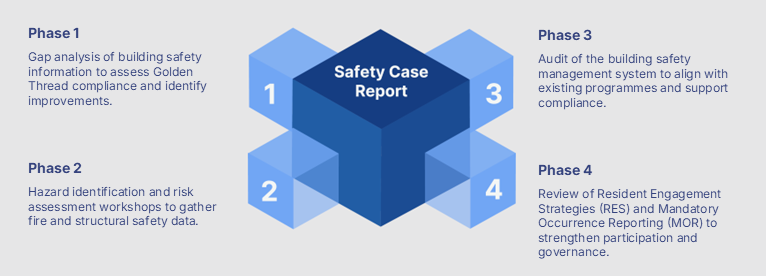
A strong Safety Case approach includes:
- A clear understanding of building risks linked to real building behaviour;
- Evidence mapped to the Golden Thread in a structured and repeatable way;
- Governance that shows control, accountability and maturity; and
- A Safety Case Report that tells a coherent story rather than a collection of documents.
A Safety Case has two sides. The first side is establishing a baseline for the Safety Case with the building information and the Golden Thread. The second side is the requirement for ongoing management of the building. From my experience, you start with the simple question of will your safety critical devices work when you need them and how do you know they will work when you need them. That is the heart of robust Safety Case.
4. Practical Steps RMCs, RTMs and Managing Agents Can Take Now
1. Establish a statutory workflow map
Define responsibilities across PAP, BSM, FM and external specialists. Without this, everything else becomes reactive. These relationships and boundaries vary based on capability, existing FM arrangements and who is used as the BSM. Using someone experienced in managing these convoluted boundaries is pivotal to safe housing. It always comes back to competency. Using competent companies and individuals is key to long lasting building safety.
2. Consolidate evidence
Create a single source of truth. Remove duplication. Bring everything together. Tools cannot fix this on their own. They only work when you already have a strong team behind them.
For me, the Golden Thread does not mean complex tools and applications. It means a coherent and well thought out filing system. Some tools do this job very well and ensure a single source of truth is available, but I have seen first-hand when this fails. Sometimes a simple solution is the best solution. This does not apply when you have a large portfolio, but for RMCs and RTMs, it works.
3. Define clear roles
RMCs need to understand what they can do, what they cannot do and what must be delegated to competent specialists. There is good guidance available. The Building Safety Regulator and The Leasehold Advisory Service (LEASE) offer free building safety training for Resident Directors. It is a four-module programme. It will not tell you how to write your own Safety Case or take on these responsibilities, but knowledge is power. There are many companies offering the world and lacking the competencies to deliver. Knowing what you need to do is a powerful attribute when making decisions.
4. Move from collecting documents to demonstrating control
Safety Case readiness is not about volume. It is about assurance and predictable delivery.
What does this mean?
- Knowledge of your building;
- Knowledge of your preventative and mitigating measures;
- Understanding of what the BSR expects to be evaluated and knowledge of safety critical devices;
- Understanding what a good resident engagement strategy looks like;
- Knowing when and how to submit a Mandatory Occurrence Report; and
- Ensuring safety is always managed, not only when you write your Safety Case.
5. Build a predictable cycle for monitoring and review
Safety Cases are living documents. Without a cycle, they become outdated and lose their value.
I like the term living. Risk is always present and your occupied building evolves. Your BSM must understand this and work with you to ensure your duties as a PAP are not diluted. There are many ways to achieve this without a full time BSM and the service charge impact that comes with it. It requires competency and ethics. A single, non-complex building can be managed safely with the right FM, the correct BSM and a genuine commitment to supporting the built environment rather than extracting every penny possible.
5. Why This Matters for Residents and Boards
A strong Safety Case approach protects volunteer directors. It reduces risk exposure and strengthens governance. It improves the quality of FM delivery and reduces dependency on individual consultants. Most importantly, it gives residents confidence that their building is being managed with clarity and purpose.
Cheaper solutions often become more expensive in the long run. Rejected Safety Cases, Building Safety Regulator (BSR) intervention and misapplied leaseholder protections are all real risks. Getting it right the first time matters.
I have spoken publicly many times and I repeat this every time. You cannot have a safe building without knowledgeable residents. Understanding your building, how your safety critical devices work, what you need to do to ensure these are not disrupted and how you can support the building as a whole is essential. This is achieved through resident engagement. The demographic of your residents plays a major role and understanding their needs, how they like to be communicated with and the language used are all pivotal.
6. About Elevate Building Safety
Elevate was built to solve the exact problems RMCs and RTMs face. It is not a tool and it is not a high cost consultancy model. It is a practical, no-frills approach designed to keep costs down while delivering the assurance the Act requires.
We use simple trackers, SharePoint and tools that are already available because they become powerful when used by people who understand the Act. The aim is to keep residents safe and to give RMCs a clear path through the complexity of the legislation.
Elevate provides:
- Safety Case development and Safety Case Reports;
- Golden Thread evidence structuring;
- Statutory workflow mapping;
- Governance and system development support;
- FM auditing and alignment;
- LDoC and LdC management with long term digital vault solutions; and
- Access to structural engineers, FM providers and specialist partners.
This approach has been shaped through real work with real RMCs. It is built on the belief that you can deliver competence and clarity without unnecessary cost. That has always been the goal. That is why I am in this space and why I am committed to helping RMCs navigate the Act with confidence.
About the Author
Dr Krish Parmar is the founder of Elevate Building Safety and a specialist in Safety Case development, statutory workflow clarity and system development for higher risk buildings. His work focuses on practical delivery for Resident Management Companies, Right to Manage companies and managing agents who need clear, competent support under the Building Safety Act. Krish’s background is in engineering, quality planning and complex risk environments. This technical experience allows Krish to firstly help organisations build predictable, evidence led systems that keep residents safe. Secondly, Krish provides volunteer directors with confidence in their statutory duties.